
This crochet hat size chart gives practical planning ranges from preemie through adult, then helps you convert an actual head measurement and swatch gauge into a starting stitch count. There is no universal count: yarn, hook size, stitch pattern, tension, fabric stretch, and intended fit all change the result.
The automatic calculator on the page converts those measurements into a target circumference, crown diameter, raw stitch count, and nearby usable pattern multiples. Completed examples remain visible for readers who prefer to follow the method without entering numbers.
Print the one-page crochet hat size chart
Need the measurements beside your project? Download the one-page hat size chart (PDF). It puts the existing head, fitted-hat circumference, height, and calculated crown-diameter ranges in one place. The age labels are planning ranges, not guaranteed sizes; measure the wearer and your own gauge before choosing a stitch count.
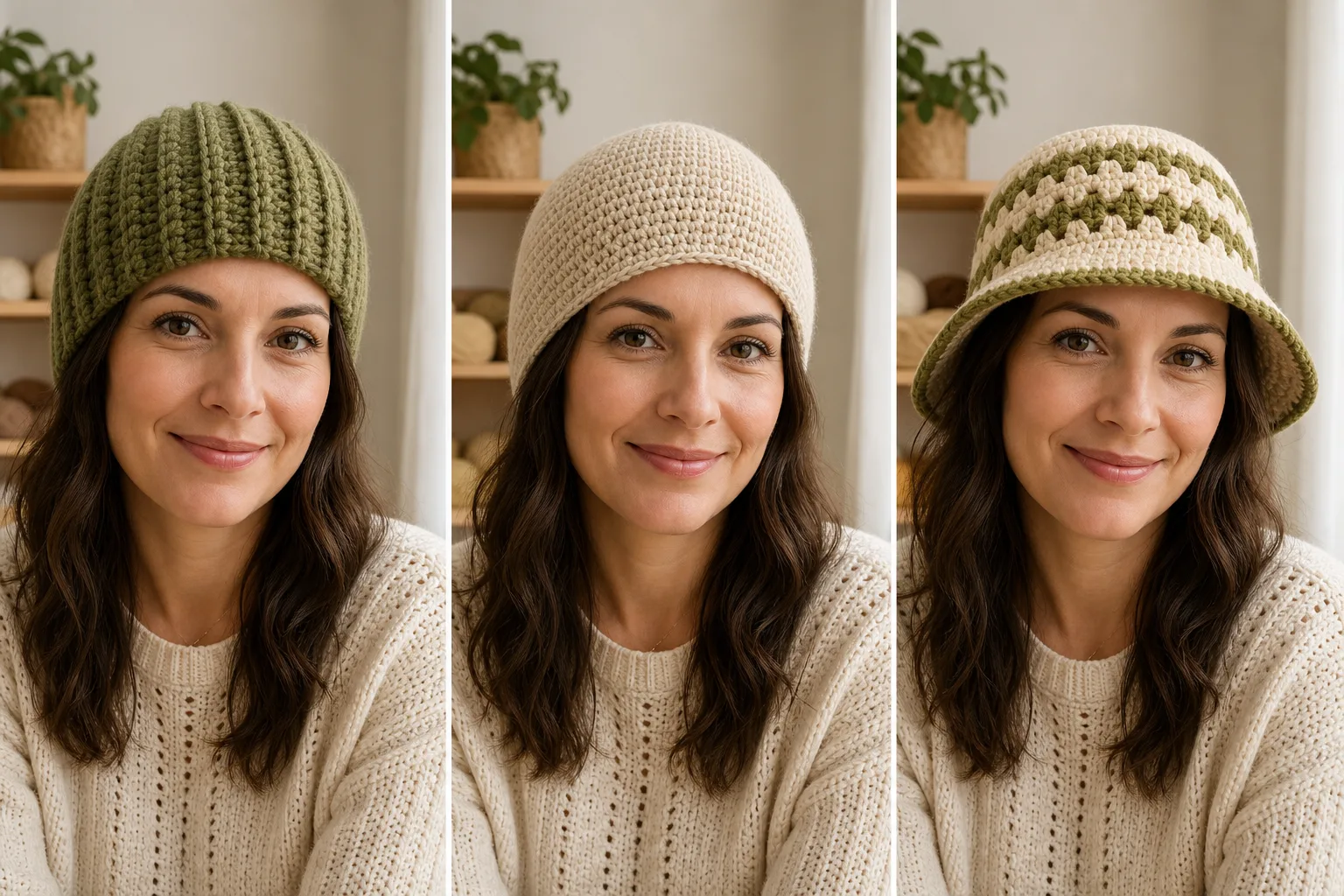
For a firm bucket hat, choose ease from the ease table rather than copying the stretchy-beanie column. Use the stitch-count calculator to turn your measured target into a pattern repeat.
Crochet Hat Size Chart
Use this chart to choose a starting range when you cannot measure the wearer. When you can measure, replace the chart’s head-circumference range with the actual number and follow the calculator sections below.
On a phone, swipe the table sideways to see all measurements.
| Planning label | Head circumference | Stretchy fitted-hat starting circumference | Typical fitted height |
|---|---|---|---|
| Preemie | 12-13 in / 30.5-33 cm | 11-12.4 in / 28-31.5 cm | 4-4.5 in / 10-11.5 cm |
| Newborn | 13-14 in / 33-35.5 cm | 12-13.3 in / 30.5-33.8 cm | 5-5.5 in / 12.5-14 cm |
| 0-3 months | 14-15 in / 35.5-38 cm | 13-14.3 in / 33-36.3 cm | 5.5-6 in / 14-15 cm |
| 3-6 months | 15-16 in / 38-40.5 cm | 14-15.2 in / 35.5-38.5 cm | 6-6.5 in / 15-16.5 cm |
| 6-12 months | 16-18 in / 40.5-45.5 cm | 15-17.1 in / 38-43.5 cm | 6.5-7 in / 16.5-18 cm |
| Toddler | 18-20 in / 45.5-51 cm | 17-19 in / 43-48.5 cm | 7-7.5 in / 18-19 cm |
| Child | 20-21 in / 51-53.5 cm | 19-20 in / 48.5-51 cm | 7.5-8 in / 19-20.5 cm |
| Teen / small adult | 21-22 in / 53.5-56 cm | 20-21 in / 51-53.5 cm | 8-8.5 in / 20.5-21.5 cm |
| Adult medium | 22-23 in / 56-58.5 cm | 21-22 in / 53.5-56 cm | 8.5-9 in / 21.5-23 cm |
| Adult large | 23-24 in / 58.5-61 cm | 22-23 in / 56-58.5 cm | 9-9.5 in / 23-24 cm |
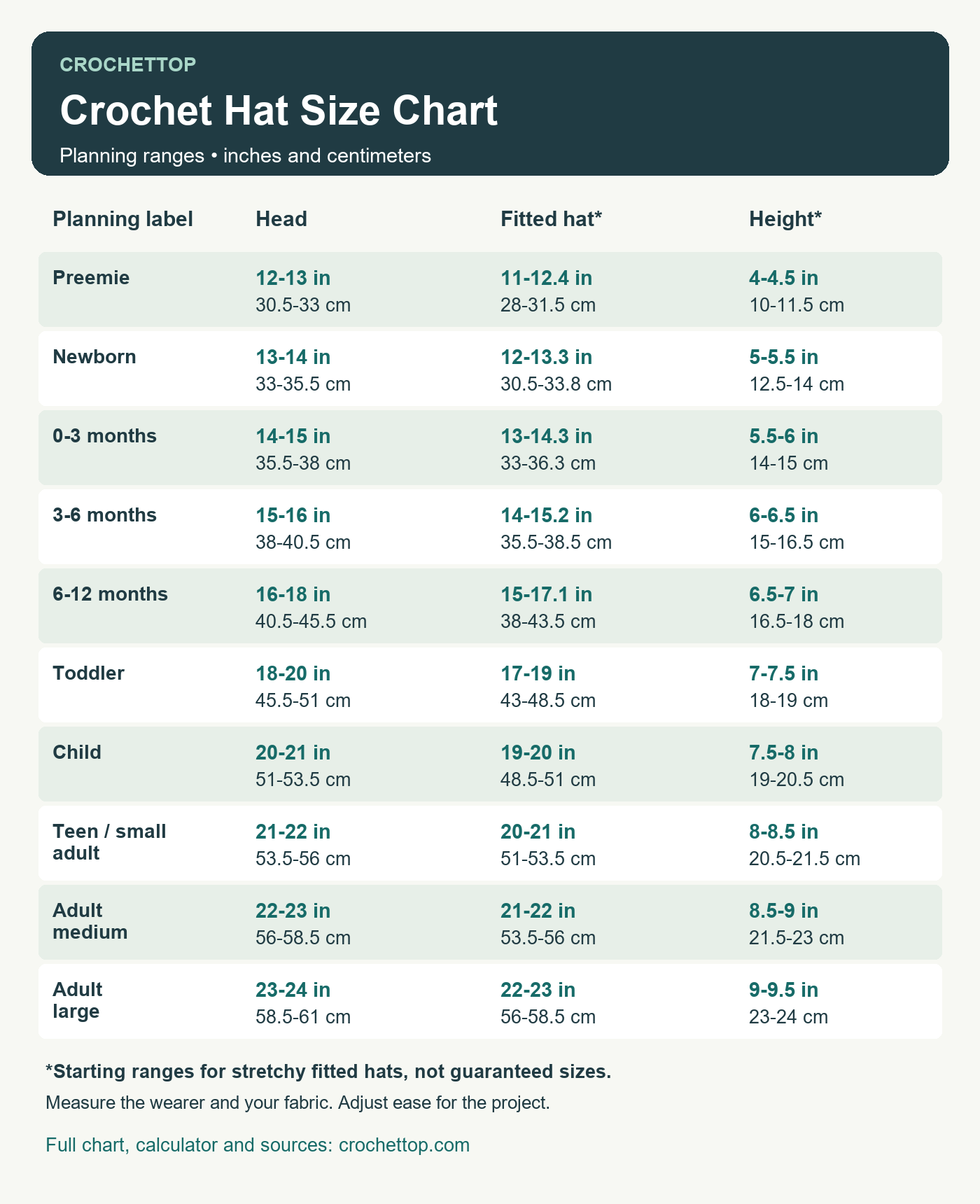
The finished-circumference column represents a broad fitted-hat starting range, not a universal standard. Use less negative ease for dense, firm, lined, colorwork, or low-stretch fabrics. Add about 1-3 in / 2.5-7.5 cm to the height for a slouchy style, then check the drape.
Use the age labels and ranges above as planning references. Head sizes vary within every age group, and yarns do not all stretch or recover in the same way. Jump to the crochet hat size chart, then use the calculator with an actual head measurement whenever possible. For babies and children, an adult should also check that the finished hat fits comfortably and does not restrict movement or vision.
Crochet Hat Size and Stitch Calculator
Open the tool in a separate page. The article also retains the manual formulas and worked checks.
JavaScript is optional: use the manual calculation method and worked examples in the article.
Why There Is No Universal Crochet Hat Stitch Count
A head measurement is a body measurement; a stitch count is a fabric instruction. The two can be connected only after you know the intended finished circumference and the gauge of the actual crochet fabric. That is why one article may use 84 stitches for an adult while another uses 90 or 96: they may be using different yarn, hooks, stitches, ease, or repeat multiples.
The four measurements below let you replace a fixed size label with a range-based decision.
Head circumference
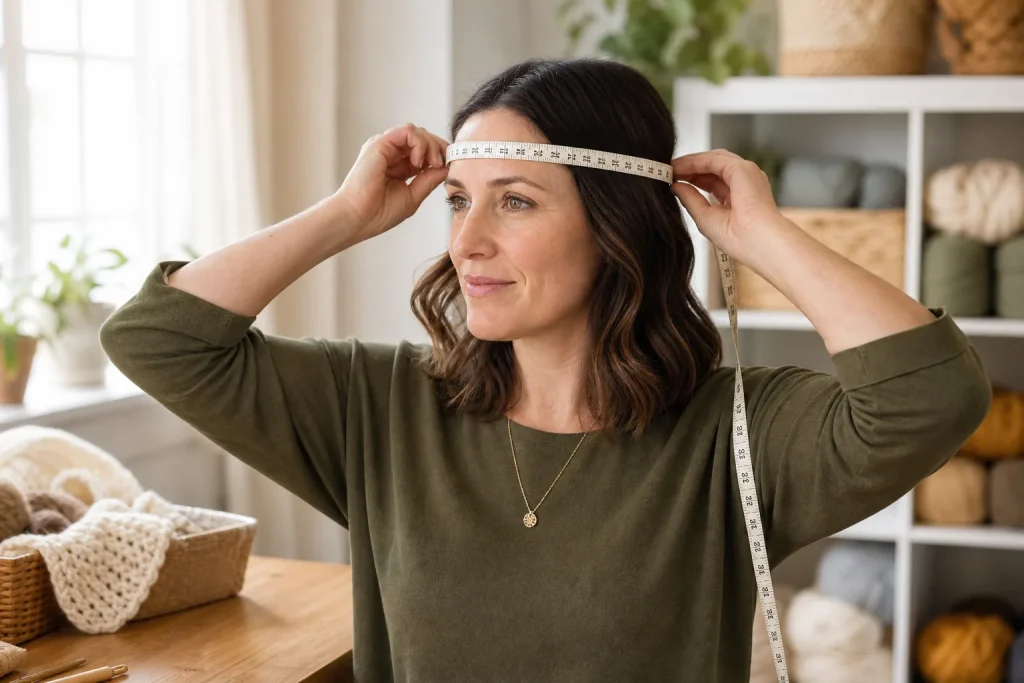
Measure around the fullest part of the head, usually above the eyebrows and ears. Keep the tape level and comfortably snug. Do not pull it tight enough to indent the skin, and do not add extra room to the measurement itself.
Finished hat circumference
This is the circumference you want the hat to have after ease is applied. A stretchy beanie is often smaller than the head so it stays in place. A structured bucket or sun hat may need little or no negative ease because the fabric has less stretch.
Crown diameter
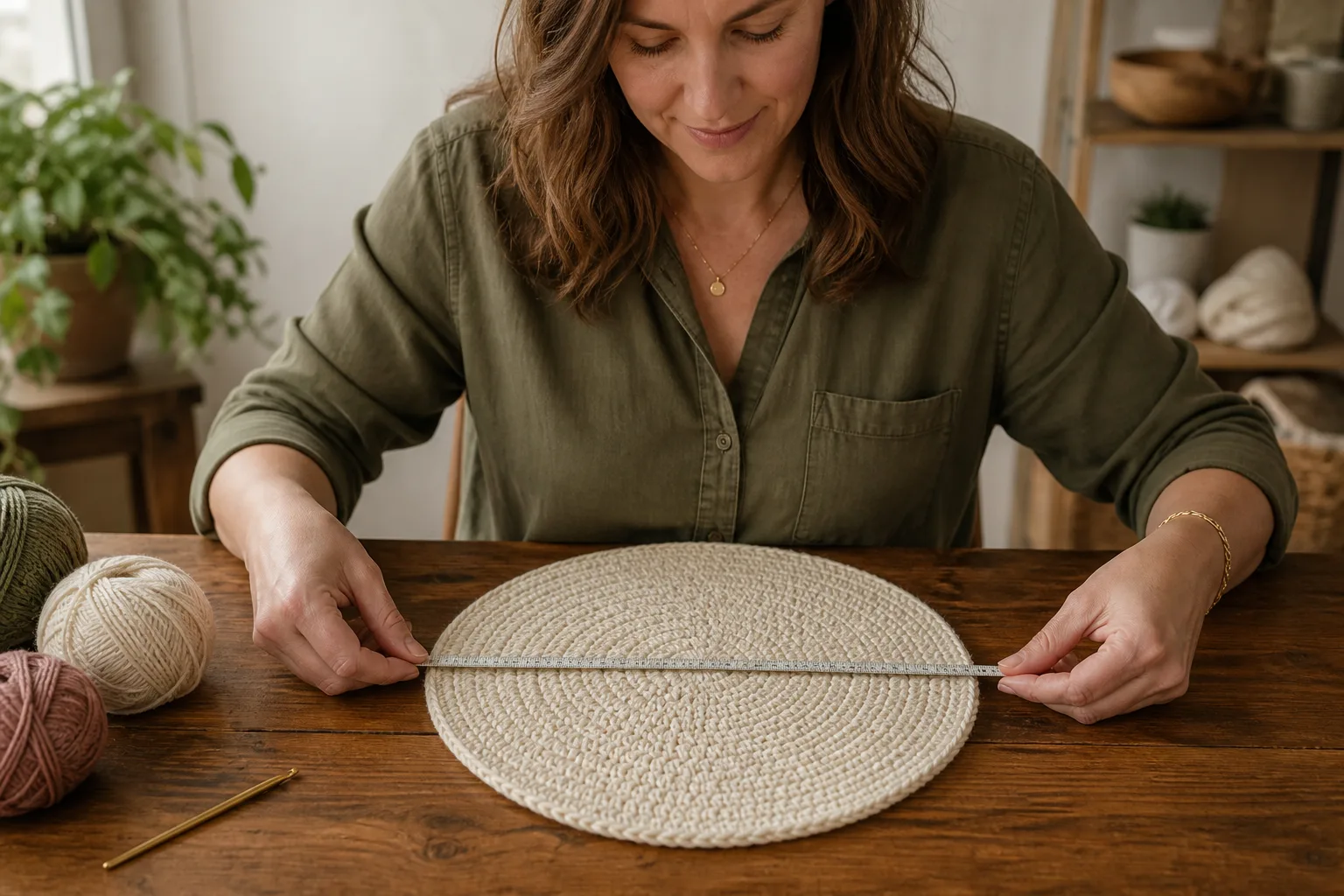
For a top-down hat that begins with a flat circle, crown diameter is the straight-line measurement across the center of that circle. It is calculated from the target finished circumference, not directly from the age label.
Hat height
Hat height is measured from the center top to the lower edge. A fitted beanie usually reaches the base of the ear or slightly below. A slouchy beanie needs extra depth, while a bucket hat may stop above the ear before the brim begins.
Choose Ease Before You Calculate
Ease is the difference between the wearer’s head circumference and the finished hat circumference. Negative ease makes the hat smaller than the head. Zero ease makes it approximately the same size. Positive ease makes it larger.
| Hat style | Starting ease | Ease factor | What to check |
|---|---|---|---|
| Stretchy fitted beanie | 5-10% negative ease | 0.90-0.95 | Test recovery; very stretchy ribbing may tolerate more negative ease. |
| Firm fitted beanie | 0-5% negative ease | 0.95-1.00 | Useful when dense stitches or firm yarn reduce stretch. |
| Bucket or structured hat | Minimal negative to zero ease | about 0.97-1.00 | Check the crown and side fit before adding the brim. |
| Slouchy beanie | Fit band snugly; add height | band often 0.90-0.95 | Create slouch with depth, not by making the band too loose. |
Crown Diameter Calculator for Top-Down Hats
A top-down hat usually begins as a circle. Once that circle reaches the calculated crown diameter, you stop increasing and begin the sides. The simple circle formula is useful, but crochet fabric is not a perfect geometric object. Stitch height, increase placement, yarn behavior, and the transition from crown to sides can all change the fit.
| Target finished circumference | Calculated flat crown diameter |
|---|---|
| 18 in / 45.7 cm | 5.7 in / 14.6 cm |
| 19 in / 48.3 cm | 6.0 in / 15.4 cm |
| 20 in / 50.8 cm | 6.4 in / 16.2 cm |
| 21 in / 53.3 cm | 6.7 in / 17.0 cm |
| 22 in / 55.9 cm | 7.0 in / 17.8 cm |
| 23 in / 58.4 cm | 7.3 in / 18.6 cm |
| 24 in / 61.0 cm | 7.6 in / 19.4 cm |
Stitch-Count Calculator
A circumference measurement tells you the required fabric size. Your stitch gauge converts that size into stitches. Measure gauge over a fabric area large enough to average several stitches, and use the same yarn, hook, and stitch pattern planned for the hat.
On the web page, enter the head measurement, chosen negative ease, swatch stitch count and width, and required repeat multiple. The calculator updates both nearby usable counts and the finished circumference each option would produce; no manual arithmetic or page editing is required.
Suppose 15 single crochet stitches measure 4 in / 10.16 cm. That is 3.75 stitches per inch or about 1.476 stitches per centimeter. A 20.9 in / 53.1 cm target circumference calculates to about 78.4 stitches. If the construction uses a multiple of six, 78 stitches is the closest usable count. At that gauge, 78 stitches predicts about 20.8 in / 52.8 cm.
Do not round automatically upward. Calculate both nearby usable counts and choose the one whose finished circumference best matches your ease goal.
Common Gauge-to-Stitch Reference Ranges
The table below converts several target finished circumferences into raw stitch counts at five common gauges. These are calculation results, not universal pattern counts. After choosing a cell, adjust it to the stitch or motif multiple required by your construction and recalculate the resulting circumference.
| Target finished circumference | 12 sts / 4 in | 14 sts / 4 in | 15 sts / 4 in | 16 sts / 4 in | 18 sts / 4 in |
|---|---|---|---|---|---|
| 18 in / 45.7 cm | 54 | 63 | 68 | 72 | 81 |
| 20 in / 50.8 cm | 60 | 70 | 75 | 80 | 90 |
| 22 in / 55.9 cm | 66 | 77 | 83 | 88 | 99 |
| 24 in / 61.0 cm | 72 | 84 | 90 | 96 | 108 |
| 26 in / 66.0 cm | 78 | 91 | 98 | 104 | 117 |
When the Result Falls Between Two Pattern Multiples
Suppose your target finished circumference is 21.5 in and your gauge is 15 stitches per 4 in. The raw result is about 80.6 stitches. If the hat construction must use a multiple of six, the nearby usable options are 78 and 84 stitches. Do not pick one by habit; compare the finished sizes and the intended fabric behavior.
| Usable repeat option | Recalculated circumference | How to choose |
|---|---|---|
| 78 stitches | 78 / 3.75 = 20.8 in | More negative ease; better candidate for a stretchy fitted fabric |
| 84 stitches | 84 / 3.75 = 22.4 in | More room; better candidate for a firm or structured fabric |
This comparison is more useful than calling 78 stitches ‘Small’ and 84 stitches ‘Medium.’ The wearer, fabric, and fit goal decide which option is appropriate.
Worked Example: Adult Fitted Beanie

| Step | Inches | Centimeters |
|---|---|---|
| Measured head | 22 in | 56 cm |
| Ease choice | 5% negative | 5% negative |
| Target circumference | 22 x 0.95 = 20.9 in | 56 x 0.95 = 53.2 cm |
| Calculated crown diameter | 20.9 / 3.1416 = 6.65 in | 53.2 / 3.1416 = 16.93 cm |
| Rounded crown checkpoint | about 6.7 in | about 16.9 cm |
At the crown checkpoint, place the work on a flat surface and measure across the center. If the crown is already cupping strongly, waving, or missing the target despite the correct round count, fix the gauge or increase problem before starting the sides.
Worked Example: Structured Bucket Hat
For a 22.5 in / 57 cm head and a firm cotton fabric, you might begin with only about 2% negative ease rather than the 5-10% often used for a stretchy beanie.
| Calculation | Inches | Centimeters |
|---|---|---|
| Target circumference | 22.5 x 0.98 = 22.05 in | 57 x 0.98 = 55.86 cm |
| Calculated crown diameter | 22.05 / 3.1416 = 7.02 in | 55.86 / 3.1416 = 17.78 cm |
| Practical checkpoint | about 7.0 in | about 17.8 cm |
The bucket-hat pattern provides calculated crown targets to compare with your own measurements. Use those checkpoints with the pattern’s stated gauge rather than replacing the pattern numbers blindly with a generic chart.
Hat Height: Measure the Style, Not Only the Age
To measure a fitted hat, place the end of the tape at the center top of the head and run it down to the point where you want the lower edge to sit. For a folded brim, include the folded section in the construction plan. For a slouchy hat, measure the fitted depth first and add the desired extra length.
- Fitted beanie: measure from center top to the base of the ear or preferred lower edge.
- Folded-brim beanie: add enough length for the fold while keeping the inner layer comfortable.
- Slouchy beanie: add about 1-3 in / 2.5-7.5 cm beyond a fitted height, depending on yarn drape.
- Bucket hat: measure the crown and straight side depth separately; the brim is a third section.
Bottom-Up and Side-to-Side Hats
Bottom-up construction
The starting edge or band should match the target finished circumference after ease. If the band uses ribbing, make a ribbing swatch and stretch it only as much as it will be worn. The body stitch gauge may differ from the band gauge.
Side-to-side construction
The row length controls hat height, while the number of rows controls circumference. Include the seam method in your planning because a bulky seam can reduce comfort and slightly change the usable width.
Motif or granny-stitch construction
Round the stitch count to the full motif repeat. If the nearest repeat produces too much size difference, change gauge or adjust the repeat with a planned transition instead of forcing an incomplete motif.
Automatic Calculator and Completed Example
The live calculator is preloaded with this 22 in / 55.9 cm example using 5% negative ease, a gauge of 15 stitches per 4 in / 10.16 cm, and a repeat multiple of six. Change any input on the web page and all results update immediately. The completed example below shows how each displayed result was produced.
| Calculation field | Formula or decision | Completed example |
|---|---|---|
| A. Actual head circumference | Measure the intended wearer | 22 in / 55.9 cm |
| B. Ease percentage | Choose for the hat style and fabric | 5% negative ease |
| C. Ease factor | 1.00 – 0.05 | 0.95 |
| D. Target circumference | A x C | 20.9 in / 53.1 cm |
| E. Crown diameter | D / 3.1416 | 6.65 in / 16.9 cm |
| F. Gauge stitches in test width | Measure the actual swatch | 15 sts in 4 in / 10.16 cm |
| G. Stitches per unit | 15 / 4 or 15 / 10.16 | 3.75 sts/in / 1.476 sts/cm |
| H. Raw stitch count | D x G | about 78.4 stitches |
| I. Pattern repeat multiple | Required by this construction | multiple of 6 |
| J. Nearby usable options | Compare the repeat below and above | 78 or 84 stitches |
| K. Chosen usable count | Select by stretch and intended fit | 78 stitches for this stretchy example |
| L. Recalculated circumference | K / G | 20.8 in / 52.8 cm |
| M. Target hat height | Measure or use a planning range | about 8.5-9 in / 21.5-23 cm |
Readers do not need to copy this explanation or calculate the fields themselves. It shows how the automatic result was produced and remains useful even when the calculator is not used.
Troubleshooting the Numbers
| Problem | Likely reason | What to try |
|---|---|---|
| Calculated size looks right, but the hat is too loose | Yarn or stitch pattern stretches more than the swatch suggested | Use more negative ease; test recovery; avoid measuring a stretched swatch |
| Hat is too tight | Too much negative ease, tight gauge, or low-stretch fabric | Recheck gauge; choose a larger usable repeat; reduce negative ease |
| Crown reaches the diameter but still cups | Missed increases, tall stitch behavior, or tight tension | Recount; compare gauge; add controlled increases before sides |
| Crown is wavy before the target diameter | Too many increases or loose tension | Undo the last increase round; recount; adjust hook if gauge is loose |
| Stitch count does not fit the repeat | Raw calculation ignored the repeat multiple | Compare the nearest lower and upper usable counts and recalculate both sizes |
| Correct circumference but wrong depth | Width and height were treated as one measurement | Change straight rounds or row length without changing circumference |
Frequently Asked Questions
How much negative ease should a crochet hat have?
A stretchy fitted beanie often starts around 5-10% negative ease. Dense or structured hats usually need less. Swatch the actual stitch pattern and judge both stretch and recovery.
Why do crown-diameter charts give different numbers?
Some charts begin with different head ranges, ease assumptions, stitch types, or rounding rules. Use the formula with your chosen target circumference, then check the actual fabric.
Should I measure the head over the ears?
Place the tape where the finished hat will sit, normally around the fullest part above the ears and eyebrows. Keep it level and comfortably snug.
Can I calculate size without making a gauge swatch?
You can estimate crown diameter from circumference, but you cannot reliably convert that size to stitches without knowing the fabric gauge. A small swatch saves more time than remaking a finished hat.
Does blocking permanently fix a hat that is too small?
Not reliably. Some fibers relax, while others recover or resist reshaping. Blocking is a finishing tool, not a substitute for the correct stitch count, gauge, and ease.
Can I use the same chart for knit and crochet hats?
Head measurements are the same, but fabric stretch and recovery can differ. Recalculate ease and stitch count from the actual crochet fabric rather than copying a knit pattern’s finished size.
The Rule That Makes Every Chart Safer
Reuse the Calculator for Your Next Hat
Once circumference, ease, crown diameter, stitch count, and repeat multiple are separated, resizing a crochet hat becomes easier to reason about. Change one input at a time in the calculator, compare the two nearby usable counts, and check the real fabric before moving from the crown to the sides or from the body to the brim.
References