
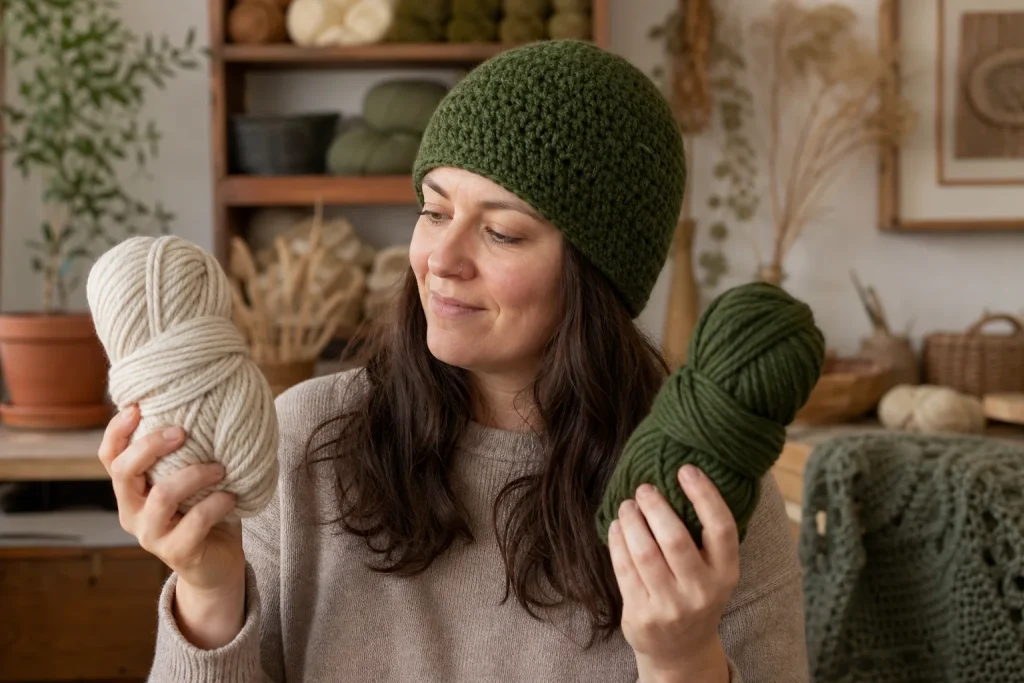
Choose for fit, weather, care, and measured project quantity
Choose yarn by the job the hat must do, confirm the fabric after washing, and estimate yards, meters, and skeins from your own swatch.
The best yarn for a crochet hat is not one fiber, brand, or weight. A close winter beanie needs different behavior from a summer sun hat, a soft baby hat, or a structured brim. The same yarn can be excellent for one of those jobs and frustrating for another.
This guide connects yarn choice to the problems that appear after the hat is worn and washed: itching at the forehead, a band that grows loose, a body that stands like a basket, a brim that collapses, or a project that runs out of yarn near the end.
You will choose the behavior first, make one washed swatch, and use the swatch in an optional yardage estimator. That is more reliable than assuming every 100 g skein contains the same length or that one skein is enough for every hat.
Yarn Choice and Yardage Planner
Open the tool in a separate page. The article also retains the manual formulas and worked checks.
JavaScript is optional: use the manual calculation method and worked examples in the article.
What this guide helps you decide
By the end, you will know:
- which yarn behaviors matter for a fitted beanie, slouchy hat, baby hat, winter hat, or brimmed hat;
- how to use fiber content as a starting clue without treating it as a guarantee;
- why yarn weight category alone does not prove that two yarns are interchangeable;
- how to check skin feel, bend, stretch, recovery, drape, and support after washing;
- how to read yards/meters and grams/ounces from a yarn label;
- how to estimate yarn from the mass of your own washed stitch fabric;
- how a folded cuff, extra slouch, dense stitch, or brim changes the amount;
- when “one skein” is a reasonable plan and when it is a close cut.
Start with the hat’s job, not the fiber name
Before comparing wool, acrylic, cotton, or blends, describe what the hat must do. Choose the two requirements that would make the project fail if they were missing.
Close-fitting everyday beanie
Prioritize comfortable sideways stretch and recovery. The lower edge should expand over the head and move back toward its resting size. Warmth, skin feel, and care come next according to the wearer.
Cold-weather hat
Prioritize warmth, wind resistance, ear coverage, and a fabric that is not forced into excessive negative ease. Fiber helps, but stitch density, air gaps, lining, thickness, and fit also change warmth.
Baby or sensitive-skin hat
Prioritize wearer-approved skin feel, washability, low shedding, and smooth stitch visibility. Do not rely on a marketing word such as “baby” or “soft” without touching and washing the actual yarn.
Slouchy hat
Prioritize drape in the body and recovery in the band. One fabric may not perform both jobs equally well, so a stable ribbed band or a second yarn can be useful when the body is intentionally fluid.
Bucket, sun, or other brimmed hat
Prioritize structure, abrasion resistance, and the correct response to moisture. A yarn that makes a beautifully draped slouch can be too relaxed for an unsupported brim.
| Hat job | Behavior that matters most | Useful starting direction | Swatch failure to watch for |
|---|---|---|---|
| Fitted beanie | Stretch plus recovery | Smooth wool blend, resilient acrylic, or another springy blend | Band stays wider after release |
| Winter hat | Warmth, comfort, dense fabric | Wool or wool blend; soft acrylic blend where easy care is essential | Fabric is warm but too rigid or itchy |
| Baby/sensitive skin | Skin comfort, washability, low shedding | Smooth washable yarn approved by the wearer/caregiver | Fuzz, irritation, difficult care, bulky seams |
| Slouchy hat | Drape in body, stable band | Drape-friendly yarn with a separately checked band | Whole hat collapses or band grows loose |
| Sun/bucket brim | Breathability and support | Cotton/plant blend, paper/raffia-style yarn, or firm blend suited to the pattern | Brim droops, flips, or becomes heavy when damp |
These are starting directions, not universal answers. The actual skein still has to pass the label and washed-swatch checks below.
Read six parts of the yarn label before buying
The yarn label is more useful than the skein’s size in your hand. Locate these six fields.
- Fiber content: the percentage of each fiber, not only the largest name on the front.
- Yarn weight category: the thickness category, commonly shown as a number from 0 to 7.
- Length: yards and/or meters in this specific skein.
- Net weight: grams and/or ounces in this specific skein.
- Care instructions: washing, drying, bleaching, ironing, and professional-care symbols.
- Dye lot: the batch identifier when the yarn uses dye lots.
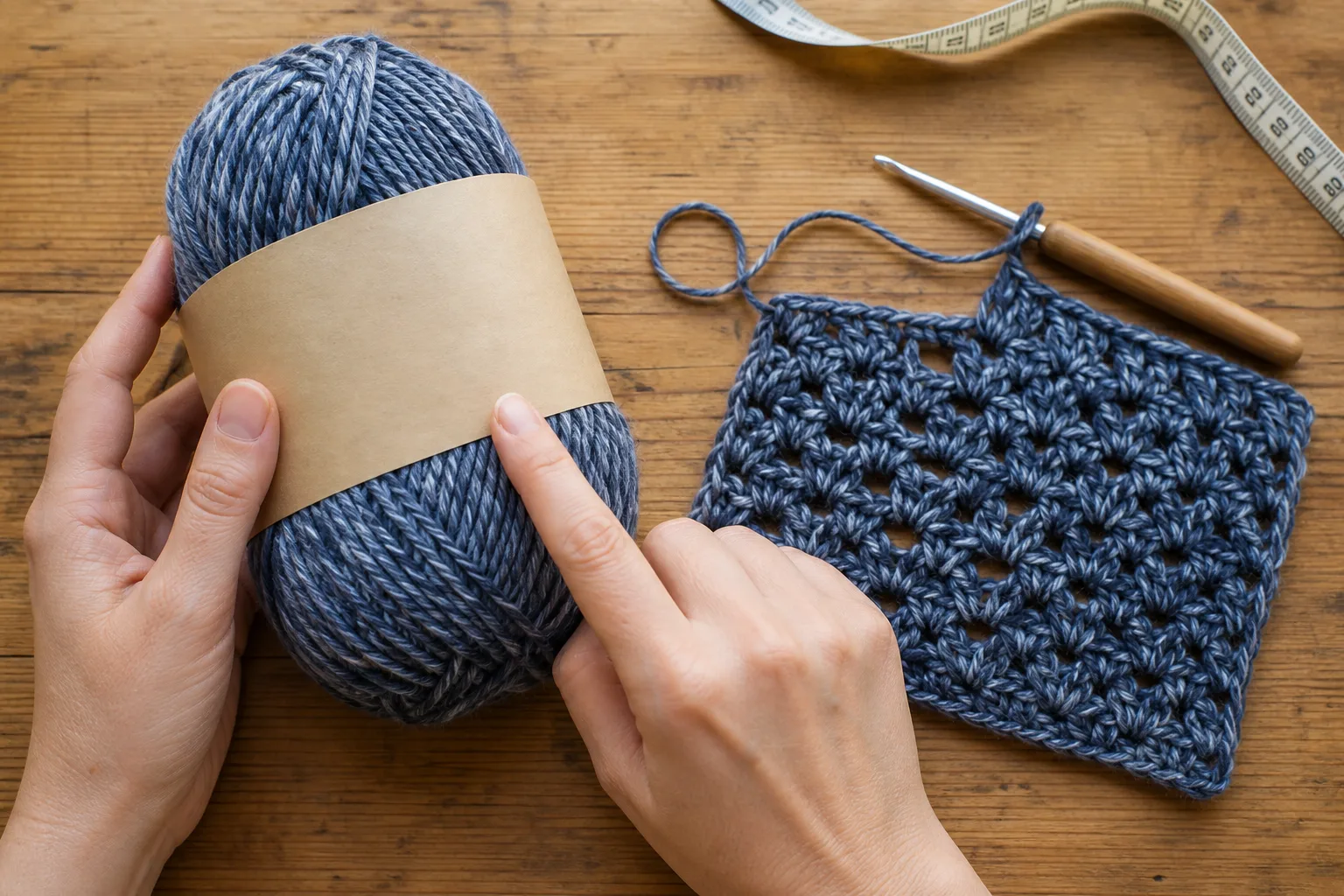
The Craft Yarn Council’s yarn-weight categories help organize thickness and typical gauge ranges. They are guidelines, not an interchangeability chart. Two category-4 yarns can have different twist, density, softness, drape, halo, and length per 100 g. Make a gauge swatch whenever you substitute yarn, even when the category number matches.
Why grams cannot replace yards or meters
Grams tell you mass. Yards or meters tell you length. A dense fiber and a lighter fiber can put different lengths into equal 100 g skeins. If a pattern calls for 180 yd and the substitute contains 120 yd per 100 g, one 100 g skein is not equivalent to another 100 g skein that contains 220 yd.
Use this conversion:
Then calculate how much length your estimated project mass represents. The optional estimator does this for you.
Use fiber as a clue, then test the actual yarn
Fiber content affects warmth, moisture response, elasticity, weight, care, and skin feel, but construction and finishing can change how a particular yarn behaves. Treat the descriptions below as shortlisting guidance.
Wool and wool blends
Wool often supplies warmth and useful resilience for fitted hats. A blend can combine wool’s behavior with easier care, durability, or a different price point. Superwash treatment changes care and fabric behavior, so read the label and wash the swatch exactly as the finished hat will be treated.
Check the actual yarn against the wearer’s forehead and ears. “Merino,” “wool,” or “luxury” does not guarantee that every wearer will find it comfortable.
Acrylic and synthetic blends
Acrylic yarns can be affordable, widely available, colorful, and easy to care for. Their softness, shine, stretch, heat response, pilling, and recovery vary widely. A smooth acrylic or acrylic blend can work well for gifts and frequently washed hats when the swatch remains comfortable and returns after stretch.
Avoid choosing only by the word “acrylic.” Compare the actual strand, label, and washed fabric.
Cotton and plant-fiber blends
Cotton and many plant-fiber yarns can feel cooler and create clear stitch definition. They are useful starting points for warm-weather or structured styles, but pure cotton commonly has less spring-back than a resilient wool or synthetic blend. A fitted cotton beanie therefore needs a recovery check, not simply more negative ease.
For a brim, structure may be helpful; for a close band, low recovery may be a problem. A blend can shift that balance.
Alpaca and other drapey animal fibers
Alpaca and similar fibers can provide warmth and softness, but a very drapey yarn may need support from its blend, stitch pattern, or band construction to keep a fitted shape. Test recovery instead of assuming warmth and softness also mean spring-back.
Fuzzy, chenille, eyelash, and highly textured yarns
Texture can hide stitches and make corrections difficult. Fibers near the eyes and face also make shedding and skin feel more important. Use a smooth yarn when the user needs to see every stitch, especially for a first hat or a precise crown.
Make one washed swatch do five jobs
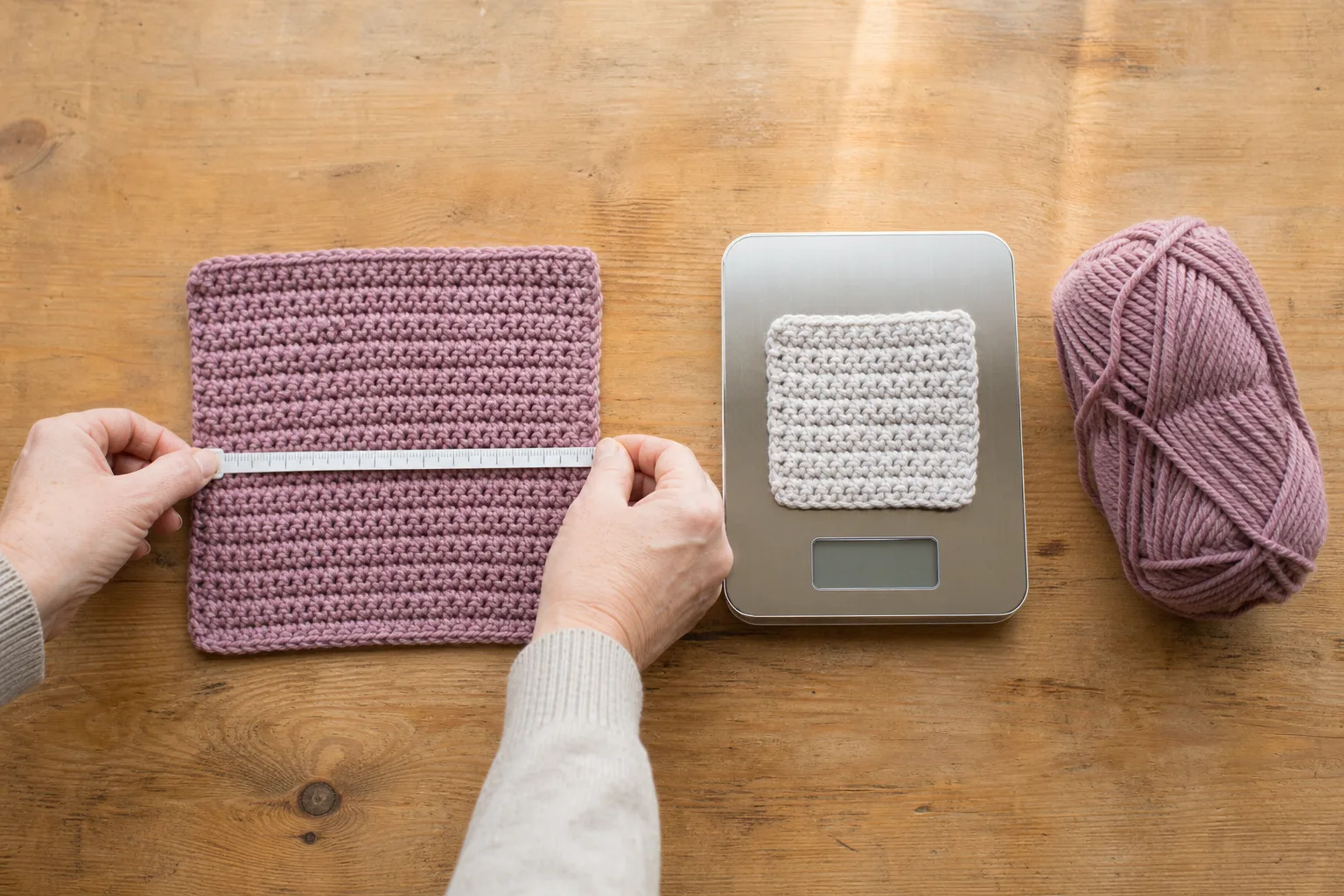
Crochet the intended stitch with the intended hook. Make the swatch large enough that the center can be measured without using the foundation edge or outermost rows. Wash and dry it according to the label and the wearer’s realistic care routine. Let it rest before checking.
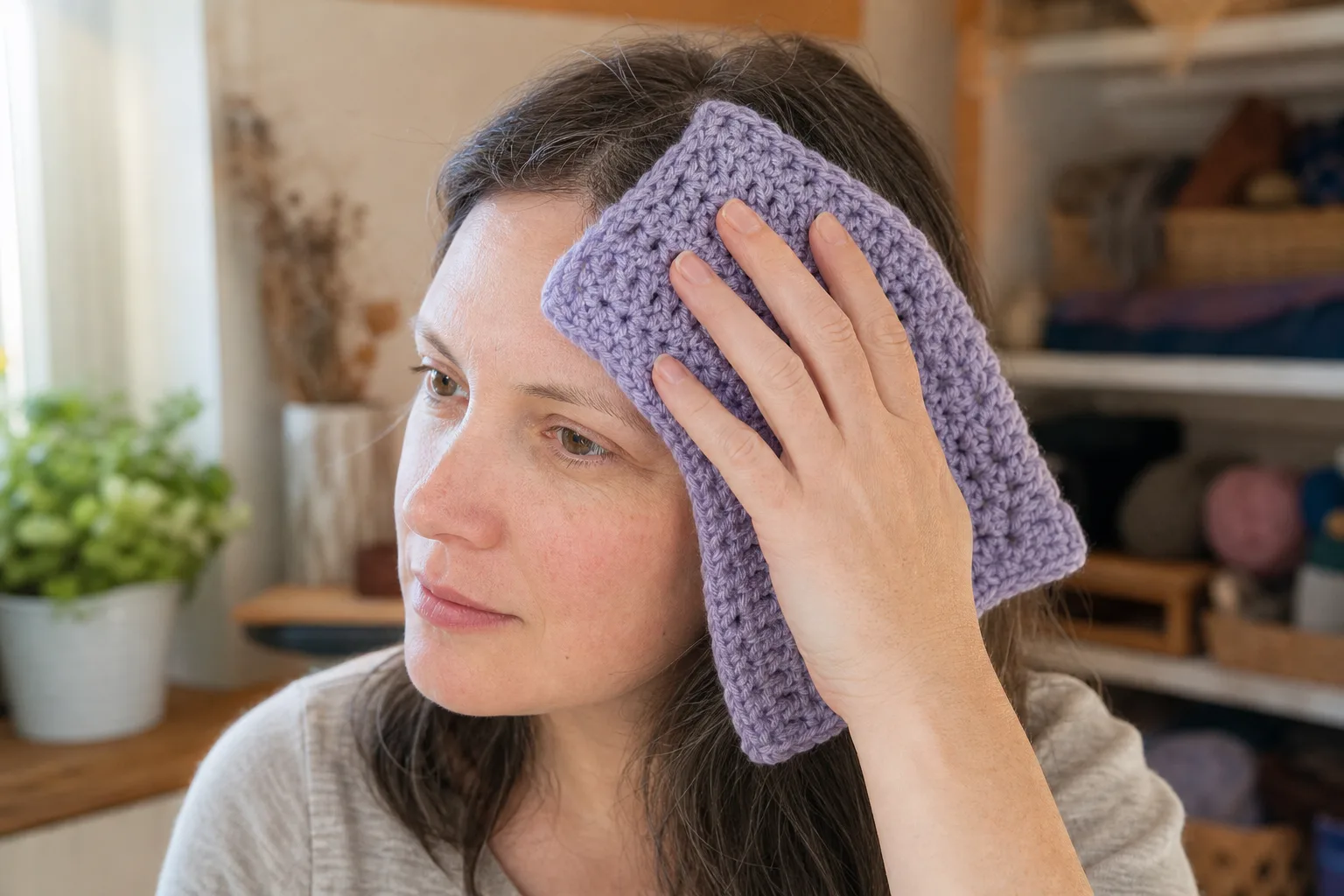
Skin-feel check
Hold the washed fabric against the forehead, ear area, or neck for several minutes without rubbing. Ask the actual wearer when possible. If it feels irritating, do not solve the problem by making the hat looser; choose a different yarn, lining strategy, or skin-contact band.
Bend check
Curve the fabric around two or three fingers. It should form the silhouette required by the hat without a hard crease or a stiff gap. Dense winter fabric can be firm; it should not behave like a basket unless structure is the goal.
Comfortable-stretch check
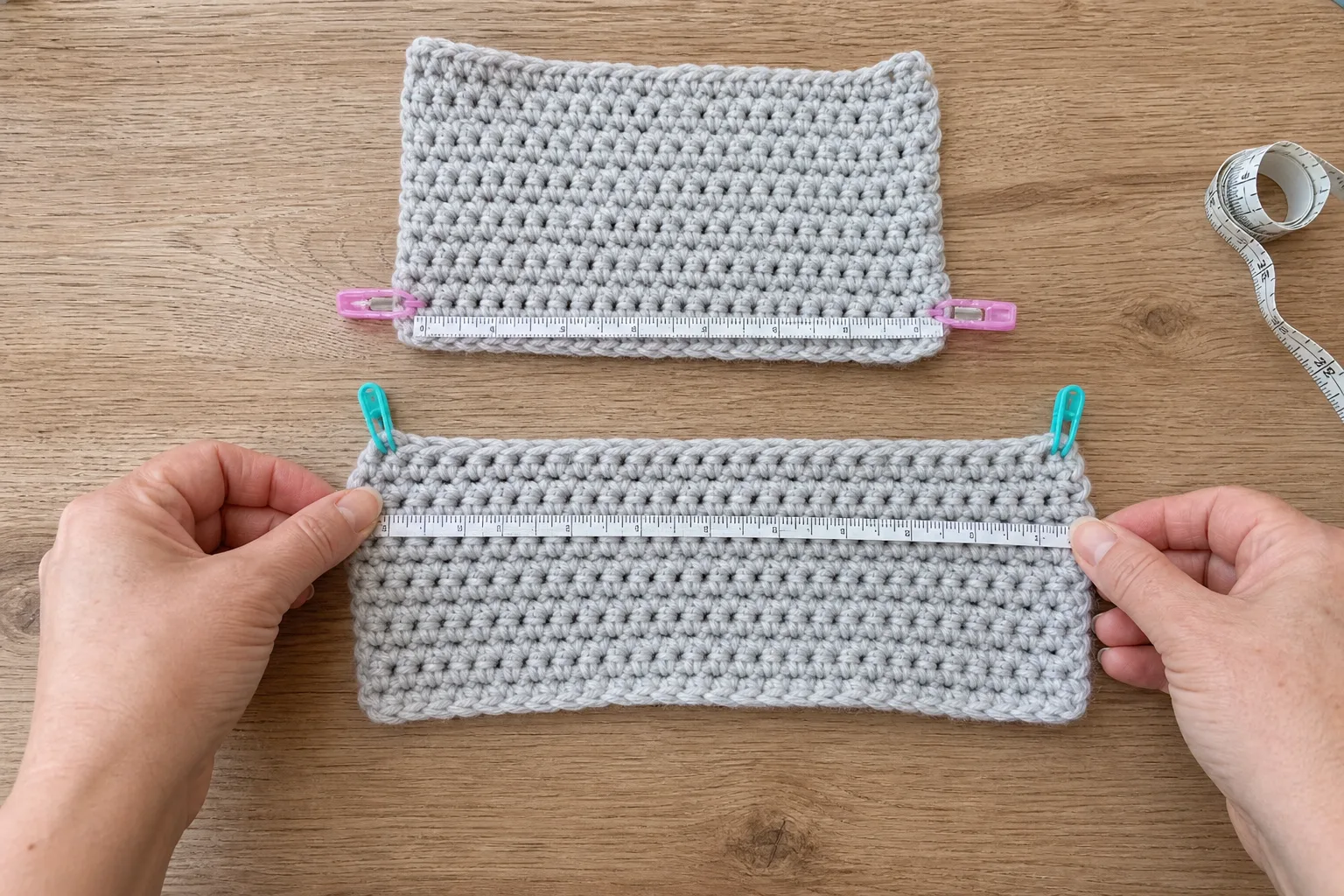
Measure a calm central width. Stretch it sideways only as far as the wearer would find comfortable, then record that width. This tells you how much negative ease the fabric can physically support without excessive pressure.
Recovery check
Release the swatch and let it rest for one minute. Measure again.
A result near the original width indicates better recovery. Do not set one pass percentage for every hat: a fitted beanie needs more recovery than a slouchy body or a firm brim.
Drape or support check
For a slouch, hold the swatch by one edge and observe whether it falls softly. For a brim, extend half the swatch beyond a table edge or hat form and observe whether it holds, bends gradually, or collapses. Use the test that matches the hat’s job.
Estimate yarn from your own fabric, not a universal chart
The website version includes the optional Crochet Hat Yardage Estimator. It opens with a complete worked example and updates immediately when the reader changes an input.
The yardage method uses the weight of the reader’s washed swatch. That captures the combined effect of fiber, yarn construction, hook, tension, and stitch pattern more directly than a generic yarn-weight multiplier.
Inputs
- actual head circumference and desired negative ease;
- planned crown-to-edge depth;
- crown diameter;
- extra folded-cuff depth, slouch depth, or brim width;
- washed swatch width, height, and mass;
- label length and label net weight;
- chosen safety margin.
Step 1: Estimate finished circumference
Let H be actual head circumference and E be desired negative ease as a decimal.
Negative ease must stay within the comfortable stretch and recovery demonstrated by the washed swatch.
Step 2: Approximate fabric area
For a top-down hat, let Dc be crown diameter and D be crown-center-to-edge depth.
For a brim, let B be brim width and R = C / (2π) be the radius at the lower edge.
This is a planning model for a hat-shaped surface. It is not a claim that every stitch consumes exactly the same amount at the crown, seam, edge, or transition. The chosen safety margin covers ordinary variation; colorwork, pom-poms, ties, lining, and unusually yarn-hungry texture should be added separately.
Step 3: Convert swatch mass into project mass
Let the washed swatch have width Ws, height Hs, and mass Ms.
Step 4: Convert mass to yards/meters and skeins
Let label length be Ll and label mass be Lm.
The optional estimator also shows how much of the final skein remains. When the plan uses nearly all of the last skein, it flags a close cut so the reader can decide whether dye-lot continuity, later modifications, or limited restock justify one additional skein.
Worked example—not a universal adult amount
Suppose the optional estimator defaults are:
- actual head circumference: 56 cm;
- desired negative ease: 8%;
- finished circumference: 51.52 cm;
- crown diameter: 16.4 cm;
- crown-to-edge depth: 21 cm;
- no folded cuff, extra slouch, or brim;
- washed swatch: 10 cm × 10 cm and 10 g;
- yarn label: 200 m per 100 g;
- safety margin: 12%.
The estimated crown area is about 211 cm². The body height is 12.8 cm, producing about 660 cm² of body area. Total planned fabric area is about 871 cm².
At 0.10 g per cm², the raw project mass is about 87 g. After the 12% margin, the plan is about 98 g and 195 m. The minimum is one 100 g skein, but it is a close cut because almost the whole skein is allocated. A folded cuff, denser washed swatch, deeper fit, pom-pom, or measurement change can move the plan into a second skein.
Change any one input and the answer changes. That is why this example is more useful as a transparent calculation than as a universal yardage chart.
How to substitute yarn without creating a second problem
Use this sequence when the pattern yarn is unavailable or unsuitable.
- Match the required hat behavior: warmth, recovery, drape, support, skin feel, and care.
- Compare the CYC weight category as a starting point, not proof of interchangeability.
- Compare label length per 100 g; equal grams can contain different lengths.
- Make and wash the intended stitch swatch.
- Confirm gauge, bend, comfortable stretch, recovery, and skin feel.
- Recalculate stitch counts in the pattern if the washed gauge changed.
- Use the new swatch mass and new label length in the yardage estimator.
Do not keep the original stitch count and original yardage automatically after changing yarn. A substitution can change fit, depth, hand, and consumption at the same time.
Match yarn decisions to this site’s hat patterns
Ribbed beanie
The ribbed fabric must recover after repeated stretch. Test the rib direction, because stretch across the ribs is not the same as stretch along them.
Baby or newborn hat
Prioritize caregiver-approved skin feel, simple care, smooth seams, and low shedding. Use actual head measurement and avoid assuming a fiber name guarantees comfort.
Slouchy beanie
Choose body drape intentionally, then confirm that the lower band has enough recovery. Add the planned slouch depth to the yardage estimator.
Sun or bucket hat
Test the actual brim support after the planned wash. Enter brim width so the annular brim area is included instead of estimating from a beanie range.
Winter hat
Judge warmth from the full fabric system: stitch density, thickness, fit, ear coverage, wind gaps, and fiber. A very warm fiber in an open or poorly fitted fabric can still miss the wearer’s needs.
Chunky or dense single-crochet hat
Bulky yarn may require fewer yards but more grams per area. Dense single crochet can also make a heavy fabric. The swatch-mass method captures that difference; a yards-only chart may not.
Troubleshooting by symptom
| What happens | Check first | Smallest useful correction |
|---|---|---|
| Hat becomes loose after washing | Washed recovery and care method | Re-swatch after realistic care; choose better recovery or redesign the band, then recalculate fit |
| Forehead or ears feel irritated | Washed skin-contact check | Change the skin-contact yarn or add an appropriate lining/band; do not solve irritation with extra looseness |
| Beanie stands away from the head | Bend test, hook, dense stitch | Try a more flexible fabric, then recalculate gauge and yardage |
| Brim droops | Washed support check and brim width | Use a firmer yarn/fabric or planned reinforcement; recalculate the brim area |
| Slouch collapses at the band | Recovery of the band fabric | Separate the band decision from the drapey body decision |
| One 100 g skein runs short | Label length, swatch mass, add-ons | Plan by yards/meters and swatch mass; include cuff, slouch, brim, colorwork, and margin |
| Substitute matches weight number but not fit | Washed gauge and hand | Re-swatch; change hook or yarn and recalculate pattern counts |
| Dark/fuzzy yarn hides stitches | Strand visibility | Use a smooth, lighter-colored yarn for a first crown or add strong task lighting |
Frequently asked questions
What is the best yarn for a crochet hat?
The best choice is the yarn that performs the hat’s specific job after washing. A fitted beanie usually needs comfortable recovery; a winter hat needs an appropriate warmth-and-density system; a baby hat needs wearer-approved comfort and practical care; a slouch needs drape plus a stable band; and a brimmed hat needs support. Fiber content helps create the shortlist, but the washed swatch decides.
Is wool or acrylic better for a crochet beanie?
Neither is automatically better. Wool can offer warmth and resilience; acrylic can offer affordability and easy care. Both categories contain yarns with different softness, twist, recovery, and wash behavior. Compare the actual labels and washed swatches against the wearer’s needs.
Can I crochet a fitted hat with cotton?
Yes, but test recovery. Cotton can create a cool, clear, structured fabric, yet many cotton fabrics do not spring back like a resilient wool or synthetic blend. A fitted cotton band may need different ease or construction than a wool-blend band.
What yarn weight should I use for a crochet hat?
Use the weight required by the pattern when following a fixed pattern, then match washed gauge. For a custom hat, choose weight according to the desired thickness, detail, speed, drape, and structure. The Craft Yarn Council ranges are useful starting guidelines; they do not replace the swatch.
How much yarn does a crochet hat need?
It depends on the finished circumference, depth, crown, cuff, slouch, brim, stitch fabric, and label length per gram. If useful, use the swatch-mass estimator rather than copying one adult range. The worked example above calculates about 98 g and 195 m only for its stated inputs.
Is one skein enough for a beanie?
Sometimes. “One skein” is not a quantity until you know the skein’s yards/meters and grams/ounces. Enter the actual label and swatch values. If the plan consumes almost all of the last skein, treat it as a close cut and consider restock and dye-lot risk before deciding.
Should I buy an extra skein?
Buy based on the optional estimator’s remaining margin and your risk. An extra skein is more valuable when the yarn has a dye lot, the style may change, the plan uses nearly all of the last skein, or restocking is difficult. It may be unnecessary when you already have a generous measured reserve and can return an unused skein.
Can two yarns with the same weight number be substituted?
Possibly, but the category number alone is not enough. Compare fiber, construction, label length, care, and the washed stitch fabric. Confirm gauge and hand before recalculating the pattern and yardage.
Final purchase check
Before buying, confirm all seven conditions:
- The yarn behavior matches the hat’s job.
- The actual wearer accepts the washed skin feel when possible.
- The swatch bends, stretches, recovers, drapes, or supports as required.
- The label care method is realistic for the wearer.
- The pattern gauge or custom calculation uses the washed swatch.
- Yardage uses label length and swatch mass, not skein count alone.
- The final-skein reserve and dye-lot risk are acceptable.
If one condition fails, change that variable before buying the full amount. Yarn choice, fit, care, and quantity are connected decisions; solving them together prevents a comfortable-looking skein from becoming an uncomfortable or unfinished hat.
References
- Craft Yarn Council: Standard Yarn Weight System
- Craft Yarn Council: Yarn Label Information
- Craft Yarn Council: Care Symbols