

Size complete pairs, keep joined rounds aligned, and shape a smooth crown
This free moss stitch crochet hat pattern replaces the usual fixed adult stitch count with a five-minute fit calculation. You will measure the washed fabric by complete moss pairs, keep the joined rounds in phase, and convert the open texture to a smooth six-sector crown.
Why moss-stitch hats lose their count
Moss stitch—also called linen stitch or granite stitch—alternates a single crochet and a chain-1 space. That simple rhythm creates three counting traps:
- counting only the visible single crochets and forgetting that every chain space is also a body position;
- working into the top of a single crochet when the next stitch belongs in the adjacent chain space;
- starting every joined round the same way, which puts a single crochet above a single crochet instead of shifting the texture.
A fourth problem appears at the top. Moss stitch is easy to work as a tube but awkward to decrease cleanly. Repeatedly deleting chain spaces can pull the fabric into ridges; cinching a full adult circumference makes a bulky starburst. The method below keeps the moss grid intact, converts it once, and shapes the remaining fabric as plain single crochet.
Project at a glance
- Skill level: confident beginner to intermediate
- Construction: ribbed band, bottom-up joined moss-stitch body, plain single-crochet crown
- Terms: US crochet terms
- Yarn: CYC #4 medium/worsted yarn with resilient recovery, approximately 180–230 yd (165–210 m) for most adult sizes
- Hooks: one hook for the body that produces your measured swatch; optionally use a hook 0.5 mm smaller for the band
- Also needed: six locking stitch markers plus one contrasting join marker, tape measure, yarn needle and scissors
The Craft Yarn Council’s standard yarn-weight system classifies worsted, afghan and aran yarns as category #4 medium, but its hook ranges are guidelines. Your washed fabric—not the label—controls this pattern.
Abbreviations
The terms below follow the Craft Yarn Council crochet abbreviations.
- BLO: back loop only
- ch: chain
- ch-1 sp: chain-1 space
- rnd: round
- sc: single crochet
- sc2tog: single crochet two together
- sc3tog: single crochet three together
- sl st: slip stitch
The turning lift and joining slip stitches do not count as body positions unless the instruction explicitly says otherwise.
UK terms: this pattern is written in US terms. US sc = UK dc, US sc2tog = UK dc2tog, and US sc3tog = UK dc3tog. Chains, chain spaces and slip stitches keep the same construction even where abbreviations differ.
Make and wash the gauge swatch
Chain an even number that makes a swatch at least 5 in (12.5 cm) wide.
- Row 1: Sc in the fourth chain from the hook, *ch 1, skip 1 chain, sc in the next chain* across. Turn.
- Row 2: Ch 2, sc in the first ch-1 space, *ch 1, sc in the next ch-1 space* across. Turn.
- Repeat Row 2 until the swatch is at least 5 in (12.5 cm) tall.
- Wash and dry the swatch as you will treat the finished hat. Let it rest flat before measuring.
Mark the left edge of one single crochet and the far edge of the chain space after it. That span is one moss pair. Measure at least seven complete pairs together in the middle of the swatch, then divide by the number of pairs. Do not include stretched edge stitches.
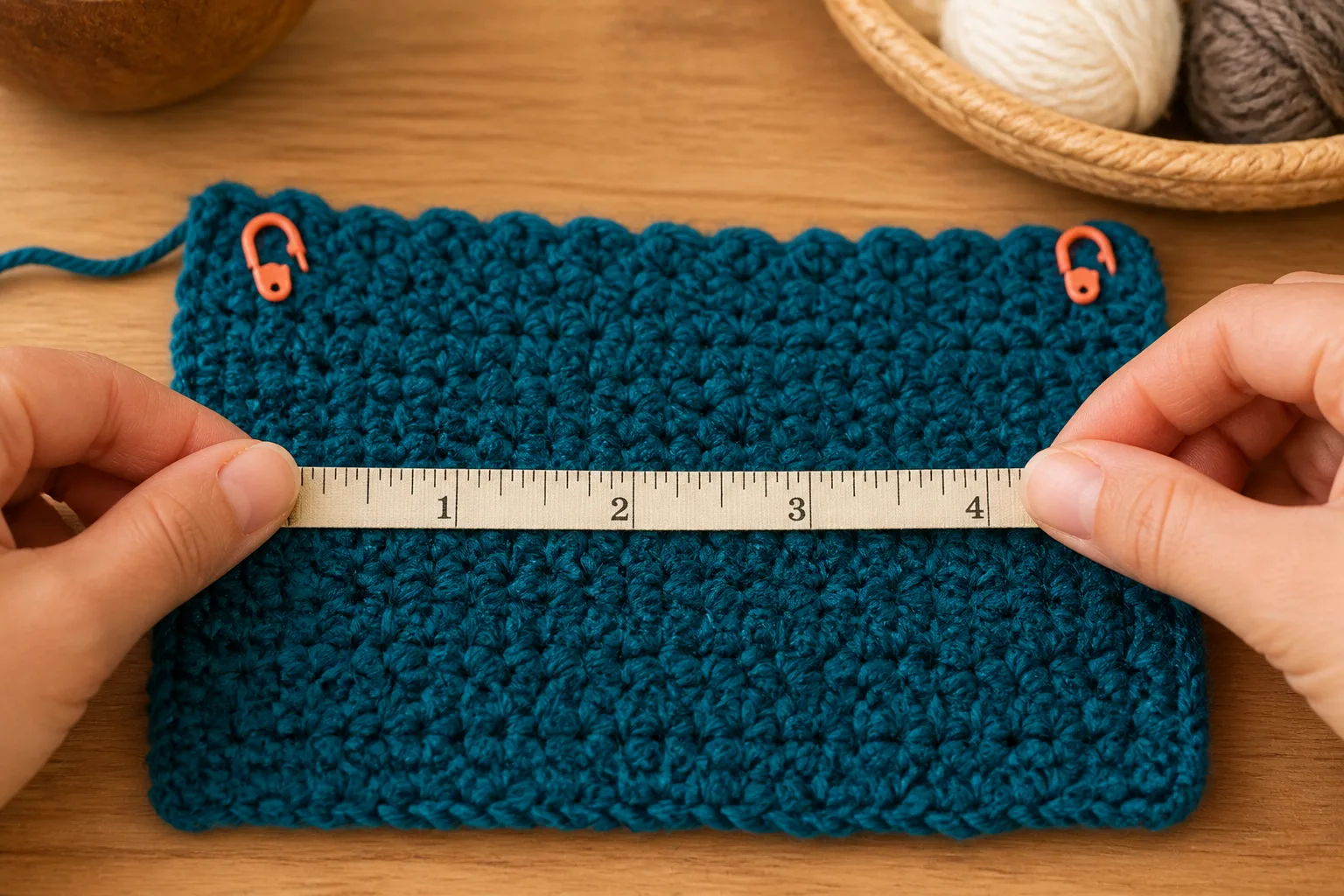
Also record three vertical gauges:
- stretched ribbing rows per inch or 2.5 cm;
- moss rounds per inch or 2.5 cm;
- plain single-crochet crown rounds per inch or 2.5 cm.
These values may differ even with the same yarn and hook.
The Moss Pair & Phase Map
Write these inputs on paper:
- H = head circumference
- e = chosen negative ease as a decimal
- W = washed width containing several complete moss pairs
- Pₛ = number of complete pairs inside W
- D = desired finished hat depth
- hᵦ = ribbed-band height
Choose a starting negative ease of about 5–10% for an adult beanie, then adjust for the washed swatch. A springy wool blend may tolerate more negative ease; firm cotton or a sensitive wearer may need less.
Calculate target circumference
Target circumference C = H × (1 − e)
Calculate the width of one moss pair
Pair width w = W ÷ Pₛ
Find a legal pair count
Raw pair count = C ÷ w
Round that result to a multiple of three pairs. Each pair has two body positions, so a multiple of three pairs produces a body count divisible by six—the count needed for the crown sectors.
Body positions B = 2 × chosen pair count
Verify the fit after rounding
Actual circumference = chosen pairs × w
Actual negative ease = (H − actual circumference) ÷ H
This second calculation matters. Legal-repeat rounding changes the fit, sometimes by several percentage points. Do not accept the rounded number until its actual ease suits the yarn and wearer.
Calculate the band rows
Measure the band swatch while it is comfortably stretched, not pulled to its limit.
Band rows = round(C × stretched band rows per inch)
The band-row count does not have to equal B. The pickup round will reconcile them evenly.
Worked example: 22 in (56 cm) head
Suppose the washed swatch shows nine complete moss pairs across 4 in (10.2 cm). The intended ease is 8%, the band gauge is 4.45 stretched rows per inch, moss gauge is 4.5 rounds per inch, and crown gauge is 5.25 rounds per inch. Desired depth is 9 in (22.9 cm), including a 2 in (5.1 cm) band.
- Target circumference: 22 × 0.92 = 20.24 in (51.4 cm).
- Pair width: 4 ÷ 9 = 0.444… in (1.13 cm).
- Raw pairs: 20.24 ÷ (4/9) = 45.54.
- Nearest legal count: 45 pairs.
- Body positions: 45 × 2 = 90.
- Actual circumference: 45 × (4/9) = 20.00 in (50.8 cm).
- Actual ease: (22 − 20) ÷ 22 = 9.1%.
- Band rows: 20.24 × 4.45 = 90.07, rounded to 90 rows.
For this particular swatch, the band and body both use 90 positions. That is a coincidence, not a rule.
Complete bottom-up pattern
Use your own calculated values in the instructions below. The example count, 90, is shown only to make the sequence easy to audit.
Part 1: Ribbed band
Chain enough stitches to make the planned band height. For a band about 2 in (5 cm) high in medium yarn, chain 9 as a starting point.
- Row 1: Sc in the second chain from the hook and in each chain across; turn. (Example: 8 sc.)
- Row 2: Ch 1, sc BLO in each stitch across; turn.
- Repeat Row 2 until you have the calculated band-row count.
- Bring the short ends together without twisting. Slip stitch through corresponding loops, or sew a low-bulk seam. Turn the seam to the inside.
Band gate: the joined band should sit firmly at the intended forehead level without leaving a deep mark. If the band works only when stretched to its absolute limit, add rows before continuing.
Part 2: Pickup round
With the larger hook if you are changing sizes, ch 1 and work B single crochets evenly around the band edge. Join with a slip stitch to the first sc. Place a contrasting marker at the join.
- If B is greater than the number of band rows, distribute the extra stitches: work two sc in evenly spaced row ends.
- If B is smaller, distribute the difference: skip evenly spaced row ends.
- Avoid making all adjustments beside the seam; that creates a visible wedge.
For the 90-row example, work 90 sc—one in each row end.
Part 3: Joined moss-stitch body
The two starts below alternate. Write A and B on your row counter, or move a second marker between two positions after each round.
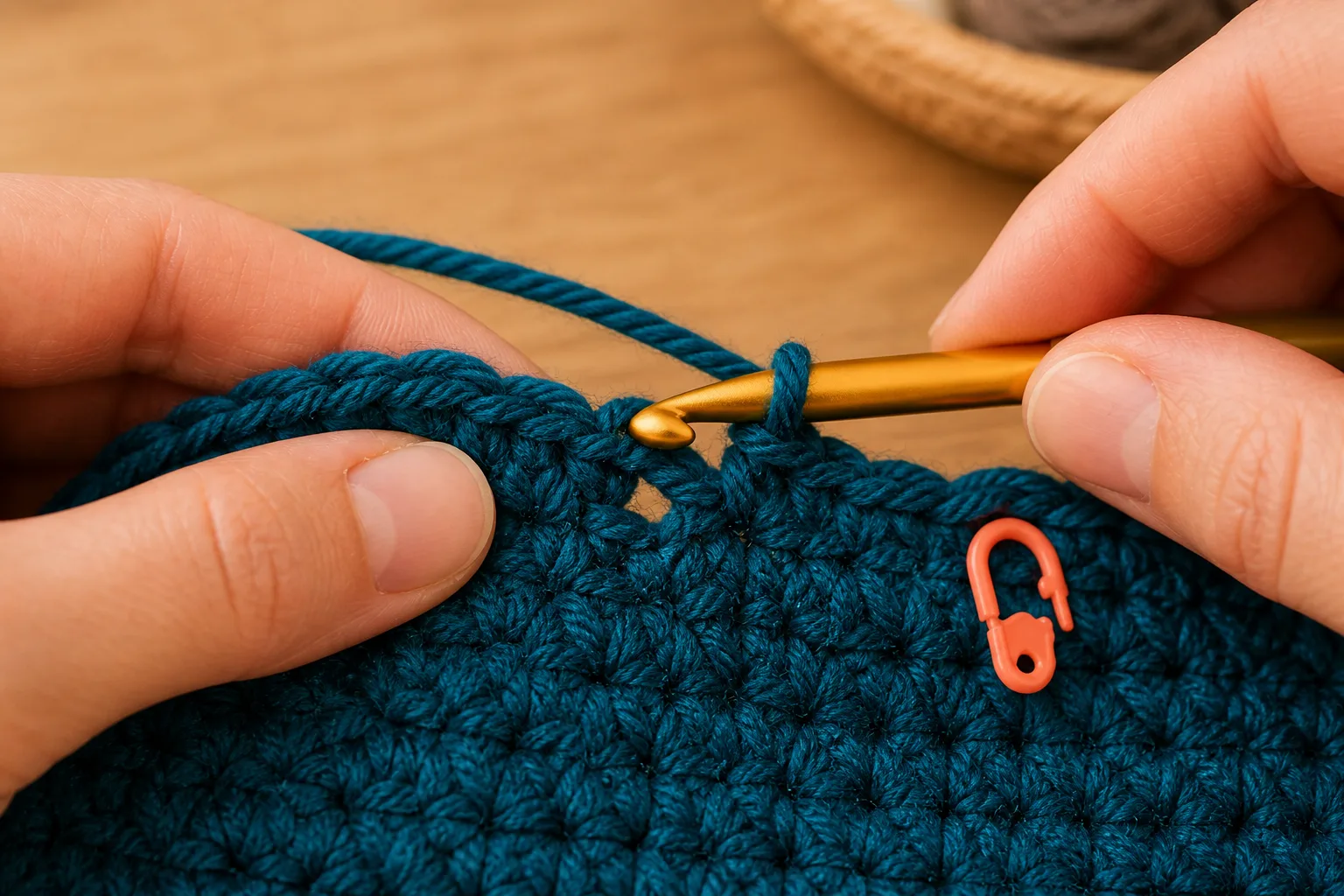
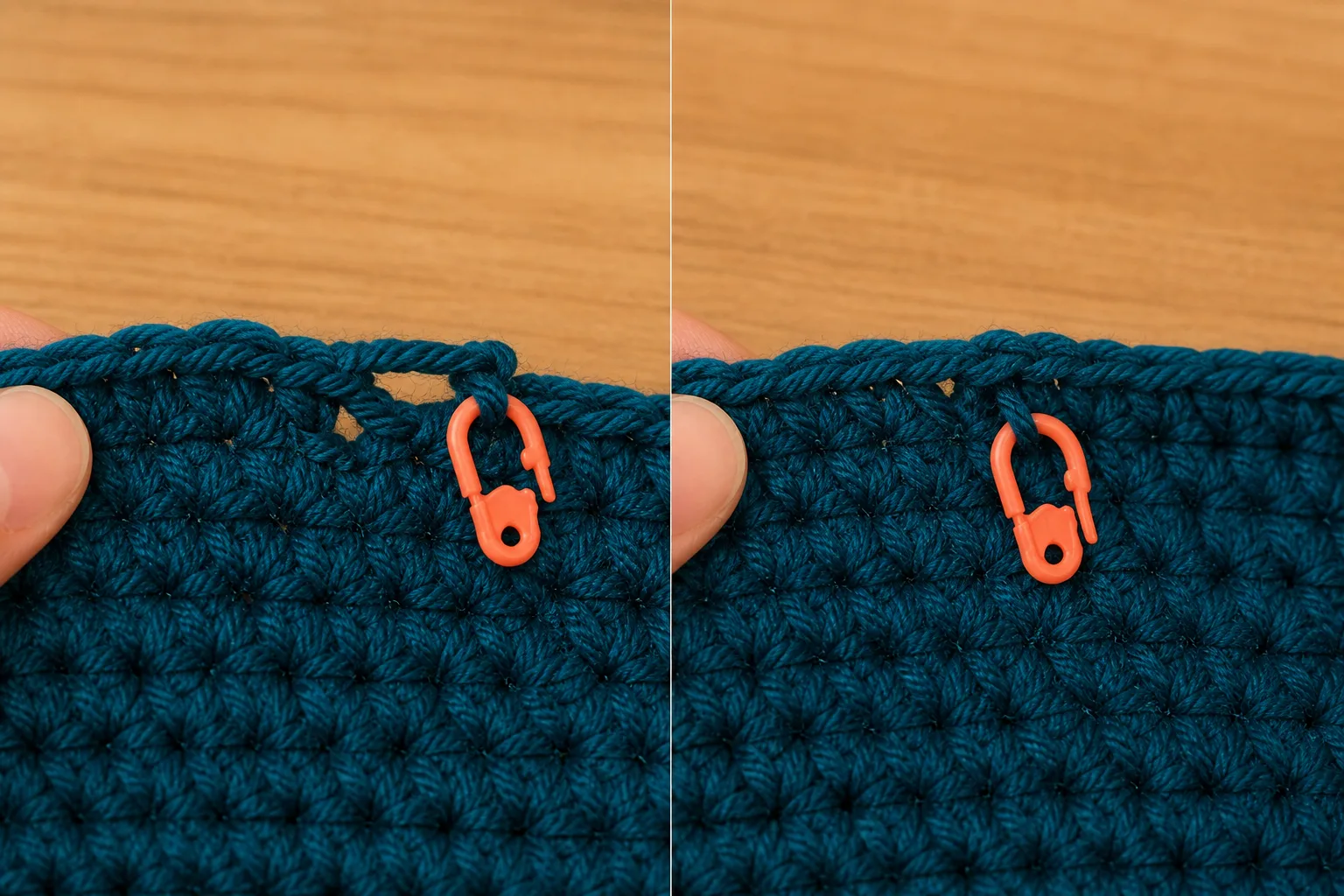
Phase A round: Ch 2. The first chain is a lift and the second chain forms the starting ch-1 space. Skip the first pickup sc, sc in the next sc, *ch 1, skip the next sc, sc in the next sc* around. Join with a slip stitch into the starting ch-1 space. Do not turn.
Phase B round: Ch 1; this does not count. Sc in the starting ch-1 space, ch 1, *sc in the next ch-1 space, ch 1* around. Join with a slip stitch to the first sc. Do not turn.
Next Phase A round: Ch 2, skip the first sc, sc in the next ch-1 space, *ch 1, sc in the next ch-1 space* around. Join into the starting ch-1 space.
Repeat Phase B and Phase A, always working each new sc into the ch-1 space below. End after a Phase B round so the body contains complete A/B cycles.
How many moss rounds?
Reserve crown depth before deciding when to stop the body.
Let s = B ÷ 6, the starting stitches in each crown sector.
- If s is odd: main decrease rounds m = (s − 3) ÷ 2.
- If s is even: main decrease rounds m = (s − 2) ÷ 2.
- Work an even sc round after the first three decrease rounds, or after all main decrease rounds if there are fewer than three.
- Crown rounds = one conversion round + m decrease rounds + those even rounds + one final decrease round.
For B = 90, s = 15. Therefore m = 6; add three even rounds, the conversion round and the final decrease round: 11 crown rounds. At 5.25 crown rounds per inch, reserve 11 ÷ 5.25 = 2.10 in (5.3 cm).
Moss height = total depth − band height − crown reserve.
Here: 9 − 2 − 2.10 = 4.90 in. At 4.5 moss rounds per inch, that is 22.05 rounds. Use 22 moss rounds, an even number that ends after a complete A/B cycle.
Part 4: Conversion round
Ch 1. Work one sc in every sc and every ch-1 space around. Join to the first sc. You now have B sc—90 in the example.
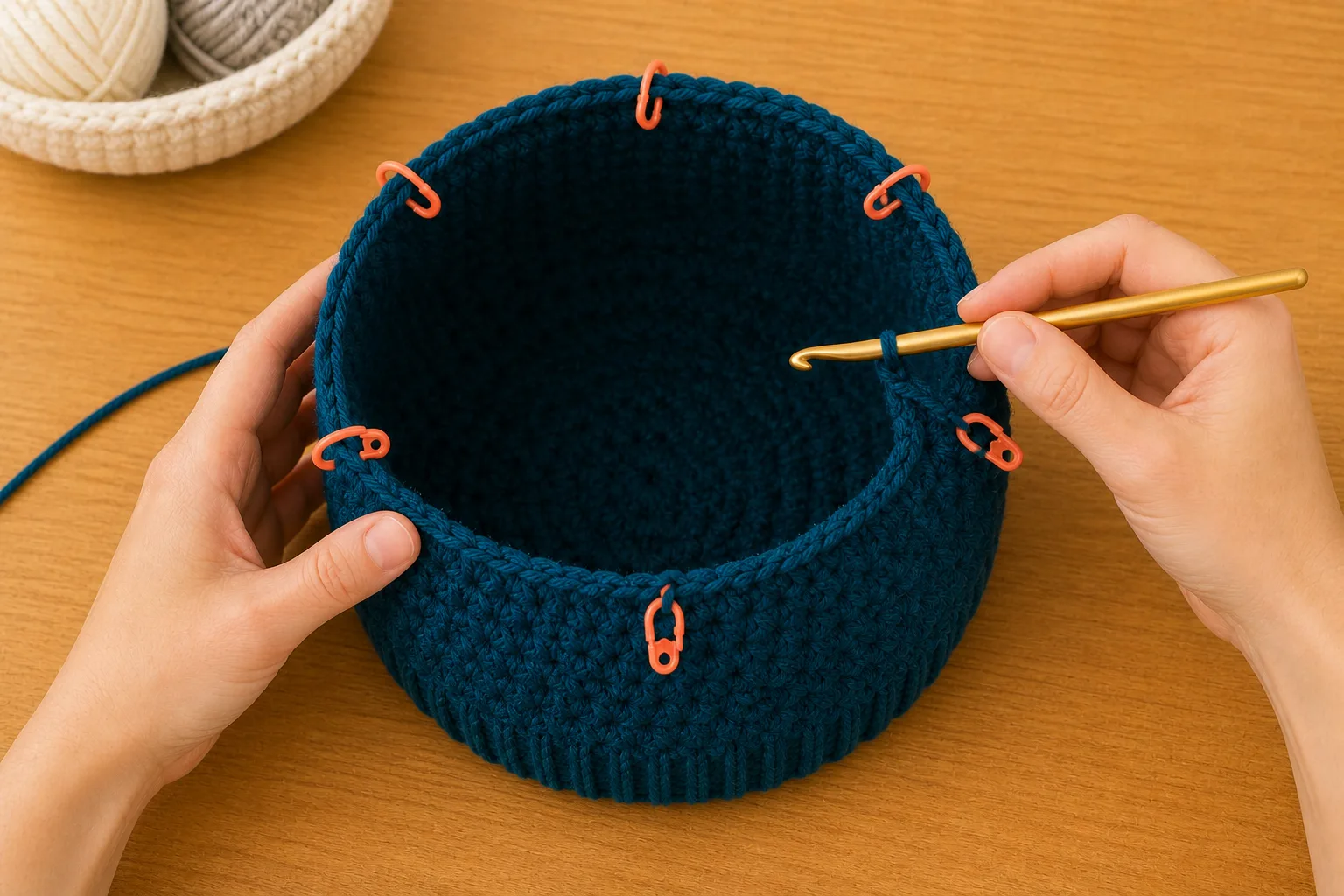
Count the entire round. Place six markers B ÷ 6 stitches apart. For 90 stitches, each sector contains 15 stitches.
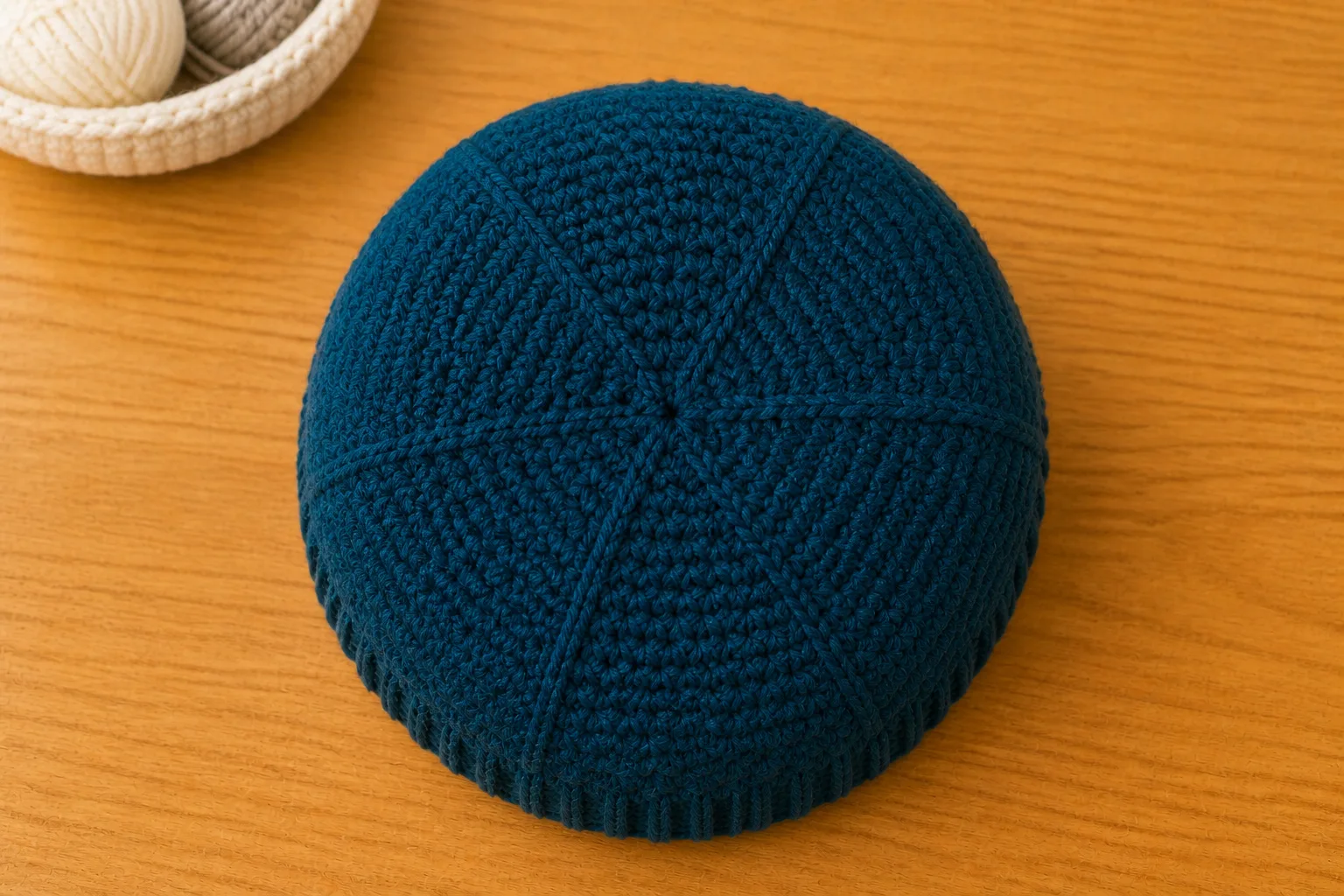
Part 5: Six-sector crown
On each decrease round, reduce two stitches per sector:
[sc2tog, sc in each stitch until two stitches remain before the next marker, sc2tog] in every sector.
Move each marker to the corresponding sector boundary as you work. The count drops by 12 stitches per decrease round.
For the 90-stitch example:
- Decrease: 90 → 78; work one even sc round.
- Decrease: 78 → 66; work one even sc round.
- Decrease: 66 → 54; work one even sc round.
- Decrease: 54 → 42.
- Decrease: 42 → 30.
- Decrease: 30 → 18.
- Final: sc3tog six times: 18 → 6.
Cut the yarn, leaving an 8 in (20 cm) tail. Thread the tail through the front loops of the final six stitches, pull closed, secure, and weave in the end on the inside.
If your final sectors contain two stitches instead of three, work sc2tog once in each sector to finish with six stitches.
Four acceptance gates
Gate 1: Washed pair gauge
The measurement spans several complete sc-plus-space pairs in the relaxed, washed center of the swatch. If you counted nine visible sc stitches but ignored the spaces between them, repeat the measurement.
Gate 2: Legal count and actual ease
The chosen pair count is divisible by three, and the resulting circumference—not merely the target—has acceptable ease. If the neighboring legal counts both feel wrong, change hook size or yarn rather than forcing the arithmetic.
Gate 3: Phase and chain-space ledger
Every round contains the planned number of sc stitches and the same number of ch-1 spaces. Phase A begins with a space; Phase B begins with an sc. If the texture stacks into vertical sc columns, undo to the last correct join.
Gate 4: Crown transfer
The body ends after Phase B, the conversion round contains B sc, and six markers divide it equally. Do not begin crown decreases until all three facts are true.
Worked Example: 23.5-Inch Head
Suppose H = 23.5 in (59.7 cm), planned ease is 6%, and nine washed pairs measure 4.25 in (10.8 cm).
- Target: 23.5 × 0.94 = 22.09 in (56.1 cm).
- Pair width: 4.25 ÷ 9 = 0.472 in (1.20 cm).
- Raw pairs: 22.09 ÷ 0.472 = 46.78.
The legal neighbors are 45 and 48 pairs. Forty-five pairs make 21.25 in (54.0 cm), or 9.6% negative ease. Forty-eight pairs make 22.67 in (57.6 cm), or 3.5% negative ease.
Choose 48 if the washed fabric has modest recovery or the wearer dislikes pressure. Choose 45 only if the yarn springs back strongly and the wearer approves the closer fit. This is why “round to the nearest repeat” is not enough: both legal counts must be translated back into an actual circumference.
With 48 pairs, B = 96 and each crown sector starts with 16 stitches. The decrease ledger is 96 → 84 → 72 → 60 → 48 → 36 → 24 → 12 → 6.
Sizing for a Child or a Gift
Use the same pair-width method for a smaller head, but recalculate from the recipient’s measurement rather than shrinking the 90-position example. When no measurement is available, start from the age range in the site’s sizing guide, compare both legal pair counts, and prefer the option with gentler compression unless the washed fabric has strong recovery.
For a gift without a try-on, complete and test the joined band before adding the moss body. Record the relaxed opening, comfortable stretched opening, and planned depth. For young children, avoid long ties or loosely attached embellishments.
Troubleshooting: Repair the Right Layer
| Symptom | Likely cause | Minimum correction | Return point |
|---|---|---|---|
| Stitch count stays even, but the texture looks striped | sc was worked into sc instead of the ch-1 space | spread the fabric and remake the round with each sc in the open space, not the V-shaped stitch top | last correct A/B round |
| Join travels sharply diagonal | joining slip stitch or starting chain was counted as a body position | mark the first true sc or starting space and rebuild the A/B ledger | last confirmed join |
| Band ripples under the body | too many pickups or a loosely measured band | recheck B and distribute pickup changes around the full circumference | pickup round |
| Body pulls inward above the band | too few pickups or a body hook that is too small | count both sc and ch-1 spaces; restore missing positions or reswatch the hook | pickup / swatch |
| Crown forms six sharp corners | decrease rounds are too close for the measured crown gauge | restore the planned early even rounds or add one measured even round | crown schedule |
| Crown is too tall | plain-sc crown rounds are taller than the sample assumption | recalculate crown reserve and remove the same excess depth from the moss body | depth budget |
Blocking can relax ordinary texture after the structure is correct. It cannot replace a missing chain space, repair an incorrect A/B phase, or correct the wrong body count.
Final checklist
- Washed pair width, band-row gauge, moss-round gauge and crown-round gauge recorded
- Chosen pair count divisible by three
- Actual circumference and actual ease checked after rounding
- Pickup round contains B stitches
- Moss rounds alternate A/B and end after Phase B
- Conversion round contains one sc in every sc and every ch-1 space
- Six equal crown sectors marked and counted
- Finished depth and comfort checked after washing
Frequently asked questions
Is moss stitch the same as linen stitch?
These names are often used for the same alternating sc and ch-1-space fabric. Some designers use “even moss stitch” for a different slip-stitch/half-double-crochet pattern, so read the stitch definition rather than relying on the name.
Can I work the body in a continuous spiral?
Yes, but the start and color changes behave differently. This pattern uses joined rounds because the Phase A/B start and count are easier to audit at a fixed marker.
Can I use DK or bulky yarn?
Yes. Make and wash the swatch, use its pair width and round gauges, and recalculate every section. Do not carry the 90-position example into a different yarn.
Why not decrease in moss stitch?
You can, but the placement is harder to read and easy to distort. The conversion round preserves the finished body texture while giving the crown a stable count and predictable decrease lines.
Can I add a folded brim?
Yes. Increase the band height before calculating total depth, and test the doubled fabric around the ears. Keep the body and crown math unchanged.